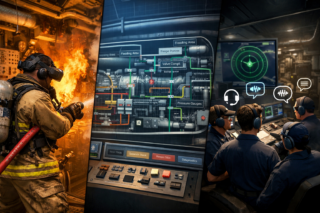
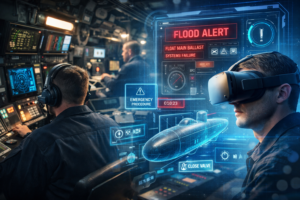
Submarine warfare compresses complex, high-stakes decisions into seconds. A propulsion casualty or flooding event can escalate rapidly, while contact management decisions may carry strategic consequences well beyond the hull. Traditional training methods—classroom instruction, desktop simulators, and limited underway exercises—provide foundational knowledge but cannot safely or repeatedly expose sailors to the full range of rare, high-risk scenarios they may encounter.
Immersive learning technologies, including virtual reality (VR), augmented reality (AR), and digital-twin simulation, offer a practical way to address this constraint. These systems allow submariners to rehearse critical procedures and decision-making processes in environments that replicate operational conditions without placing crews or platforms at risk.
A synthesis of 15 peer-reviewed studies published between 2020 and 2025 demonstrates that immersive learning, when integrated deliberately into training pipelines, produces measurable improvements in warfighter competency. Across studies, learners showed gains in procedural accuracy, decision speed, team coordination, and confidence compared to traditional methods alone. These improvements were not tied primarily to visual realism, but to how closely system behavior, feedback, and task logic mirrored real shipboard conditions.
Immersive environments are particularly effective for rehearsing low-frequency, high-consequence events—scenarios that are essential for readiness but difficult to train safely in live settings. By enabling repeated exposure to these events, immersive systems support skill automation, reduce error rates, and improve performance under pressure.
Importantly, the evidence indicates that immersive learning is not inherently superior by virtue of technology alone. Its effectiveness depends on sound instructional design, appropriate pacing, and alignment with operational tasks. When these conditions are met, immersive learning becomes a force multiplier for readiness rather than a novelty.
As submarine systems grow more complex and operational demands increase, training approaches must evolve accordingly. Immersive learning provides a scalable, evidence-supported means of preparing sailors for the realities of undersea warfare while preserving safety, resources, and operational availability.